A county fair pulling 3,000 people over a weekend needs restrooms sized to peak-hour crowds, not average attendance. Victorville Porta Pros builds fair restroom plans around gate counts, food vendor rows and grandstand seating, mixing standard units with ADA-accessible units and handwash stations.
Fair crowds cluster hard around gates, food rows and stages, so a flat per-person ratio undersells peak demand. OSHA 1926.51(c) sets a baseline of 1 toilet for every 20 people on a worksite, and fair organizers use that as a floor, then add units near concessions and the grandstand where lines actually form. A fair expecting 3,000 people across a weekend typically needs a mix of standard portable toilets and at least one accessible unit per cluster, since ADA Standards section 213.2 requires 5 percent of clustered single-user units to be accessible, with a minimum of one no matter how small the cluster. Our placement guide walks through gate zones, vendor rows and parking lot spacing in more detail, and our restroom count calculator breaks the math down by expected attendance and event length. For events near Spring Valley Lake, 7.4 miles southeast of Victorville, we plan the same way: gate flow first, then fill gaps. A fairground with a beer garden or wine tent adds another wrinkle, since alcohol service concentrates restroom demand near that one tent rather than spreading it evenly across the grounds.
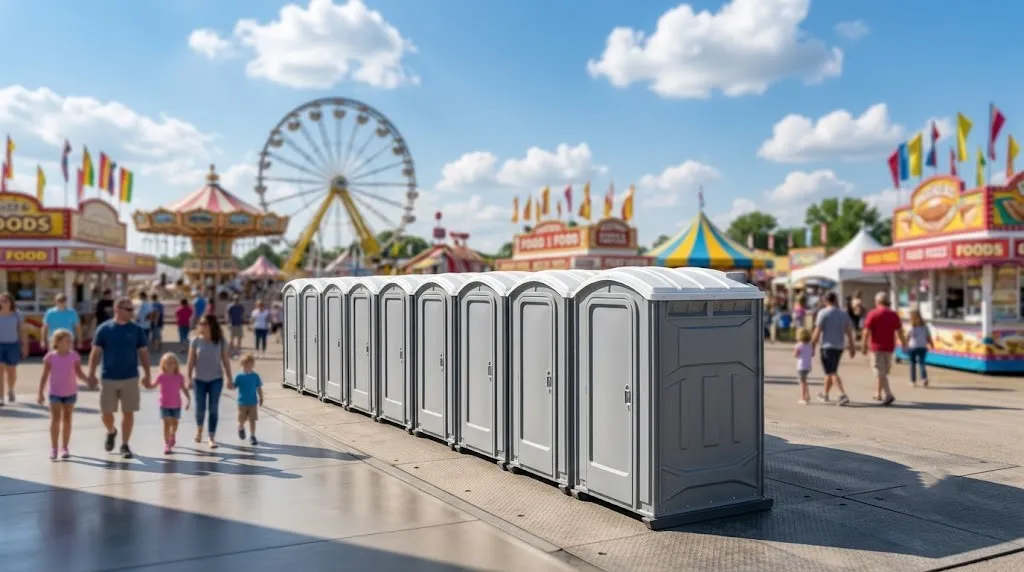
Standard units handle midway traffic and vendor rows, while a restroom trailer gives VIP ticket holders or sponsors something nicer near the grandstand. A 4 stall restroom trailer or 8 stall restroom trailer moves more people through in less time than the same footprint of single units, which matters when an act finishes and 200 people head for the restroom at once. Each standard unit carries a 60 to 70 gallon holding tank and stands about 92 inches tall, sized to handle a full day of fairground traffic between service visits. ANSI/PSAI Z4.3 sets a baseline service interval of once weekly for up to 10 users across a 40 hour week, but a multi-day fair with thousands of daily visitors needs servicing scheduled around actual attendance, not that baseline. We also stage handwashing stations near food vendor rows, since 29 CFR 1910.141(d)2) requires soap and towels or a hand-drying device, not sanitizer alone, anywhere food is being served. Fairs with livestock barns or 4-H exhibits sometimes need farm and agricultural restroom setups run alongside the main midway units, and organizers pumping large volumes through concession trailers should ask about grease trap pumping for anything with a fryer.
Fairground ground is often uneven, packed dirt or gravel lots, and units placed on a slope or soft spot become unstable fast with thousands of people cycling through. ADA Standards section 302.1 requires floor and ground surfaces under accessible units to be stable, firm and slip resistant, which rules out loose gravel or soft turf for those unit pads specifically. ADA Standards section 403.5.1 also requires 36 inches of clear route width to reach each accessible unit, so pathways between vendor booths and restroom clusters need to stay that wide even as booths get added closer to event day. A roll-off delivery for fairground cleanup needs about 60 feet of straight clearance behind the truck, which affects where dumpsters and restroom clusters can share a service road inside the grounds. We coordinate with fair organizers in Victorville and nearby Adelanto, 8.5 miles northwest, on load-in routes before the gates open, since the same access road often has to serve dumpster deliveries, water trucks and restroom trailers over the same few hours. If the fairgrounds sit in the public right of way at any entrance point, that placement needs confirming with the city before delivery, since we do not assume a permit rule without checking first. For lighting after dark, a light tower rental keeps restroom clusters visible along the midway once the sun goes down.
Fair budgets vary a lot by how many units, how long the run is and whether trailers are involved, so here is a rough range across common fair setups:
| unit | duration | typical range |
|---|---|---|
| standard | weekend | $125 to $400 |
| ada | weekend | $199 to $300 |
| deluxe | weekend | see quote, varies by trailer size |
| trailer | weekend | $900 to $3,000 |
Multi-day fairs sometimes fall under an event rate instead of a weekend rate, so check our rental cost breakdown and per-day pricing guide before locking in a headcount. This page belongs to our broader event restroom rental planning, alongside festival restroom rental and concert restroom rental setups we run across Victorville fairgrounds and open lots.
Book as early as the fairgrounds contract allows, ideally 60 to 90 days out for a multi-day event. Fair season overlaps with wedding and construction demand, and trailer units especially book out fast. Request a quote once headcounts firm up.
Yes, if units are available nearby. We keep standard units in reserve during fair weekends specifically for this. Call the day-of number on your contract rather than waiting, since same-day delivery depends on truck routing.
Yes, especially near food vendor rows. 29 CFR 1910.141(d)(2) requires soap and a towel or drying device wherever handwashing is provided, not sanitizer alone. We place stations at vendor rows and restroom clusters both.
Yes, wherever units are clustered. ADA Standards section 213.2 requires at least 5 percent of clustered units to be accessible, with a minimum of one per cluster regardless of total count. We plan clusters around this from the first layout draft.
Units get pumped and hauled out as part of teardown, on the same schedule as your roll-off dumpster pickup. We coordinate exit routes ahead of time so both trucks can clear the grounds without blocking each other.
Yes. Victorville Porta Pros delivers county fair restrooms across Victorville and the surrounding metro, with same-day and next-day drop-off available on most orders.
Pricing depends on the unit and how long you need it. See our cost breakdown and request a free quote for an exact figure.
Standard rentals include scheduled service — a pump-out, a clean, a restock and fresh deodorizer. Busy or hot-weather sites can be serviced more often.
Call now or request a free quote — clean units, on-time delivery, transparent pricing.